
Show Don't Hype recap: Agentic Design
Three founding designers, three companies, three very different setups. What Søren, Niko and Farouk showed us live, plus answers to the questions you asked.
65 minutes, three live demos, one fireside chat, and no slides (well, almost: Niko snuck one in).
Why we did this
Design has been declared dead by AI more times than we can count. We wanted to see what it actually looks like when designers work with agents every day. Not the hype. The real setups, the messy Figma files and the parts that still need a human.
So on Tuesday, 27 October, we hosted the first edition of the Show Don't Hype event. Three founding designers shared their screens and showed us how they work.
Who was there
- Søren Clausen, Founding Product Designer, Palette (Copenhagen). Fifteen years in design, previously at Podimo. His LinkedIn posts about designing Palette in Palette are the reason this event exists.
- Niko Salkola, Founding Designer, Zero (Helsinki). Zero is the agentic CRM, which recently raised its seed round and came out of beta. Niko is Zero's only designer and now builds the front end himself.
- Farouk Tahri, Founding Brand Designer and Engineer, Gladia (Paris). Gladia is the audio API that records, transcribes and enriches audio in one go. Farouk is its only designer, and he has made it possible for everyone at the company to design.
- Silja Hürlimann (host), Founding Growth, Palette (Copenhagen). Silja initiated and hosts this online series. She also represents the non-designers who use these design systems to create growth and GTM assets.
Søren from Palette: the designer as decision-maker
Søren started with a prompt most of us have written: one line that asks the agent for a full prototype. The result looks impressive. Then a colleague asks why it works the way it does, and you can't answer, because the agent made all the decisions.
His fix: he asked Palette to grill him on how he thinks about design. The answers became a shared Process folder that forces the agent to think before it designs. For a new feature (showing what an agent changed in a document), the agent first wrote up the problems ranked by importance, the users and the scenarios. Søren read them, decided what he agreed with and picked one scenario. Then the agent split the work into five scopes and explored each one in Figma, using Palette's design system.
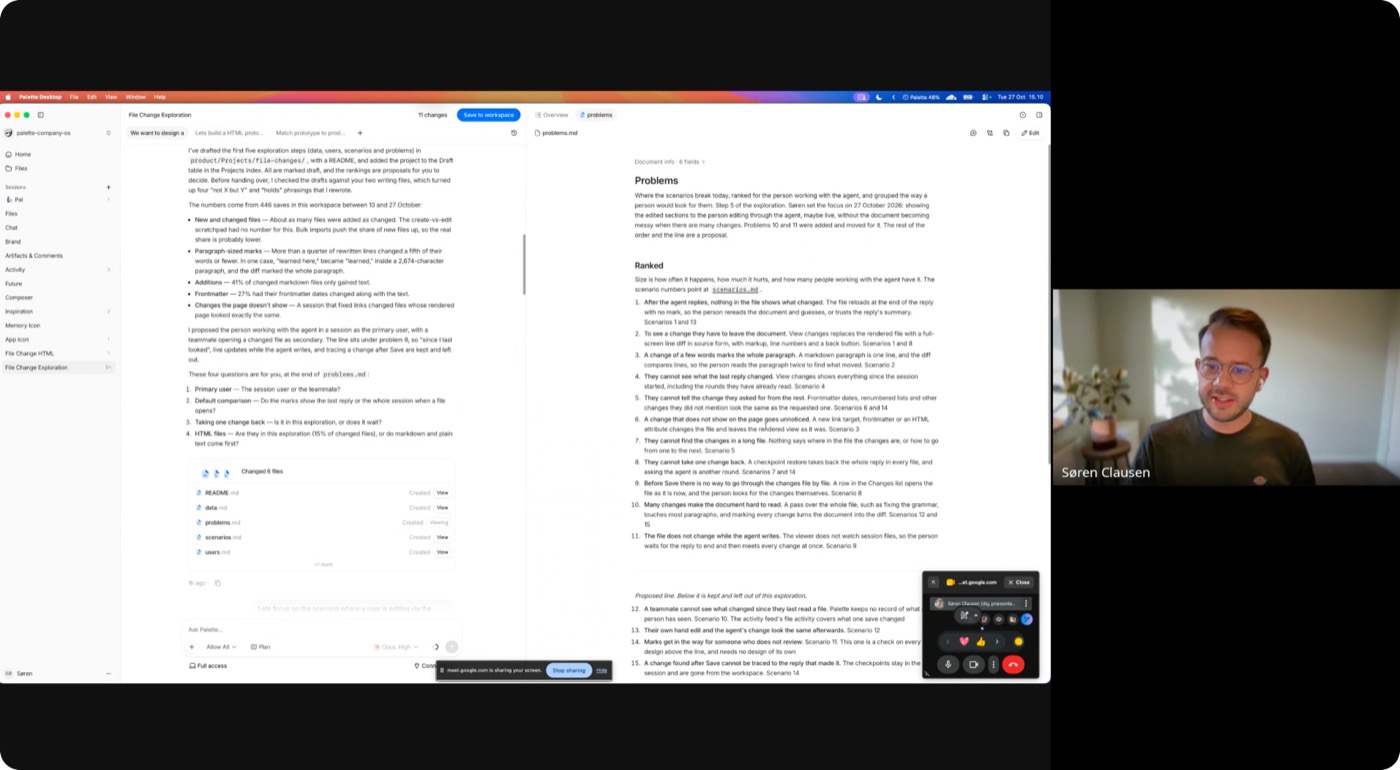
From there it was rounds of feedback. Søren chose what he liked, the agent iterated and kept the docs up to date, including open questions he hadn't thought of yet. The final HTML prototype followed every decision he made.
"I've had to kind of give up on my ownership of design to accept that other people can also design, which is probably the biggest mental shift for me at least."
Søren Clausen, Founding Product Designer, Palette
The whole thing took about an hour and a half instead of maybe a week. And because the process lives in a shared folder, every decision lands in shared lessons and log files that the rest of the team (and their agents) pick up. At Palette that is twelve people and one official designer, and everyone designs.
Want to work like Søren? Borrow his Design OS →
Niko from Zero: the designer as builder
Niko took us back to the before times: Figma specs for developers, which could never cover every state the product could end up in.
Then he showed the after. When Zero went fully product-led in mid-September, the team had two weeks to design what happens when a trial ends. AI dug through Zero's product analytics and found a clear pattern: workspaces that adopted more features were more likely to convert. So Niko designed a Spotify Wrapped style recap that shows each team what it achieved during the trial.
His Figma file for it? Untitled, chaotic and proudly shown on screen.
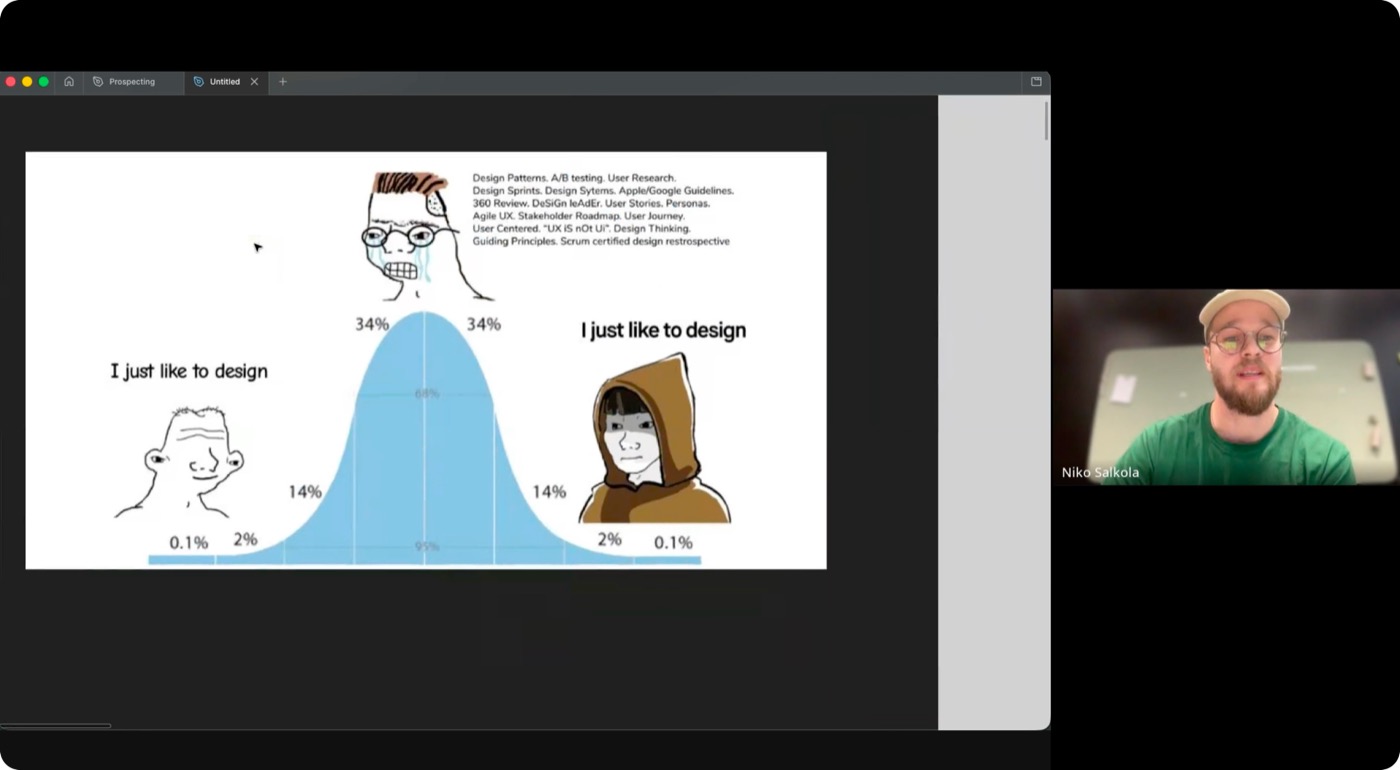
The visuals lived in his head, because he built the front end himself with Claude Code. AI helped him simulate what admins and members would see, and fill the screens with real customer numbers instead of generic placeholders. Developers own the hard parts: the Stripe integration, the credit calculations and the code quality of whatever goes to main.
"AI is not just helping me to build this straight to the production, but AI is helping me to do better decisions."
Niko Salkola, Founding Designer, Zero
And then the fun part: a launch-offer price tag with real physics and a control panel to tune it. Something nobody would ever write a spec for.
Farouk from Gladia: the designer as system keeper
Farouk's setup started small: he asked Claude to audit Gladia's website against the design system. Today it is Gladia Studio, an internal app where anyone can prompt a social visual or a video. Behind it is a design MCP connected to a GitHub repo he calls Design System 2.0, plus Gladia's knowledge vault, website, Slack and recordings. So the prompt can be short and the agent still knows what the feature is.
Two things stood out:
- He opened the black box. Farouk built a live view of what his agents are doing, so he can see whether they actually use the design MCP or wander off.
- He built a pre-flight check. Before anyone sees a first version, the agent checks its work against Gladia's anti-AI-slop rules. For one simple LinkedIn visual, it read the design MCP 8 times and the files 17 times, and edited the asset 10 times. That is why the first versions are clean.
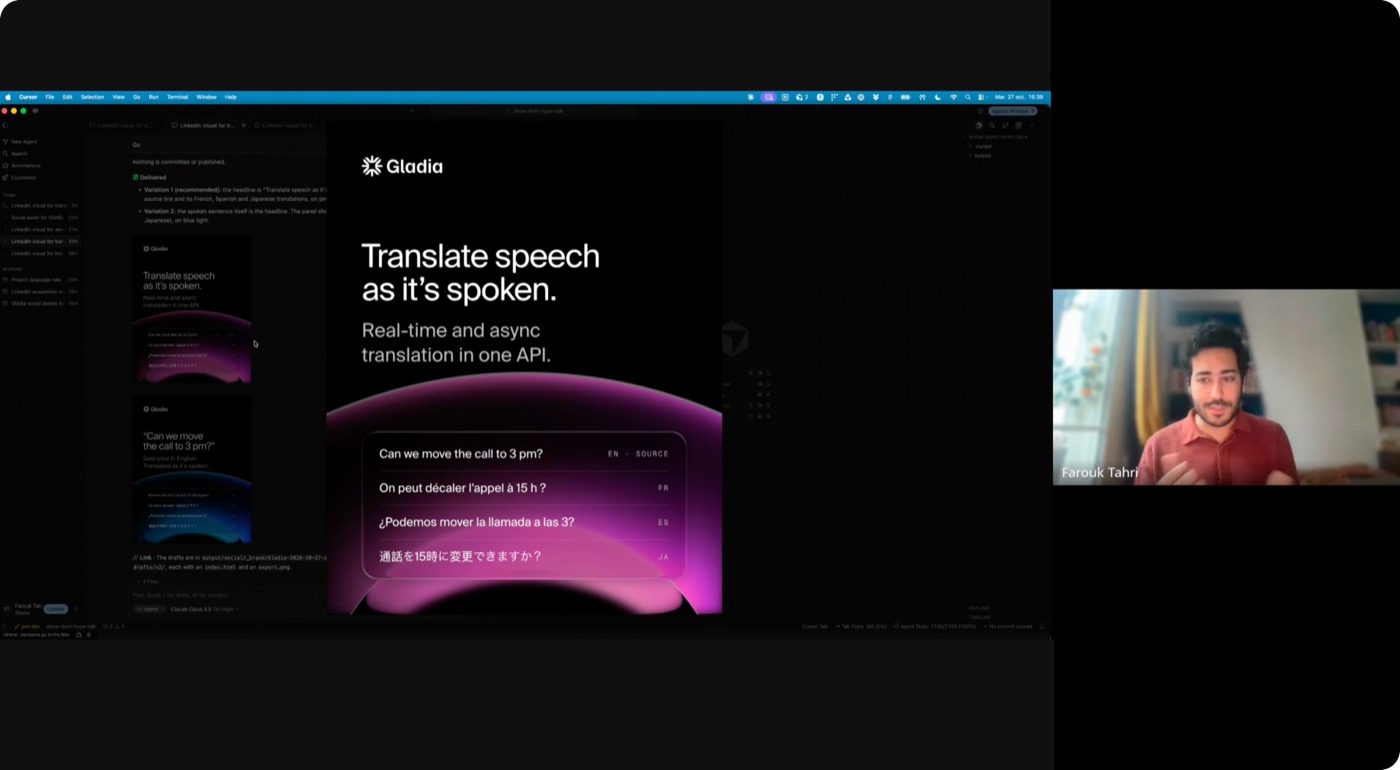
The result: the CEO, the COO, content marketing, sales and engineers all make assets. One forward-deployed engineer, Hugo, made a product video Farouk called high-quality senior motion design work.
"It shows how much our role has been evolving from pure craft, which is something that still happens, to orchestrating a system, thinking about what taste should be and how we can actually encode it somewhere so people can use it."
Farouk Tahri, Founding Brand Designer and Engineer, Gladia
One thing to try tomorrow
- Niko: build a crafted hobby project that solves a real problem. He is building an app for his friends and a gym app for himself. It is a good sandbox for trying new models and tools.
- Søren: put your context somewhere your team can share it, and don't be afraid to share your personal documentation. Things don't have to be perfect to be shared.
Your questions, answered
You asked a lot in the chat. We promised answers, so here they are.
Will the recording be shared?
Yes. It's at the top of this page.
Is it possible to get a template for the README.md?
Søren: Yes. The README I use is part of the Design OS, together with the Process folder and the rules and lessons files the agents read before they design. You can get the Design OS here. Mine started as a few lines and has changed a lot since, so treat it as a starting point for your own.
At which level, how and why do you still use Figma?
Søren: I use Figma for messy explorations. Most of the time I work in Figma through Palette and Claude. The agent builds the explorations in Figma from our design system, and then I mess around with them by hand. What I change by hand becomes the prompt for the next exploration, or for refining an idea further.
Should we still do wireframes?
The full question: getting to the final view so quickly, with every state and edge case, can become a soft cushion that reduces critical thinking. Should we still do wireframes?
Søren: There are several reasons to make wireframes, and two of them are still valid. One is to decide the structure before the details. The other is to agree on the scope before anyone spends time on visuals.
I have not made a wireframe myself in years. I make a lot of quick mockups with our design system, and they are fast enough to throw away when the structure or the scope turns out to be wrong.
The risk in the question is real, and it happened to me. A mockup made from the design system looks finished, so it is easy to stop thinking about the problem. That is why the agent writes up the users, the scenarios and the problems ranked by importance before anything is designed, and why I decide what I agree with before the first mockup.
How do you collect feedback while working in code?
Søren: Most feedback comes before I touch code. Some of it comes in conversations with the team. Some comes as comments on prototypes in Palette, and some as comments in Figma. By the time a design reaches code, most of the decisions have already been discussed.
Is it more fun than ever to work on a product?
The full question: it's never been more fun to work on a product. Do you agree, and why?
Søren: Yes, completely! 🎉 I have been designing for fifteen years, and this is the most fun I have ever had. An idea I have in the morning can be eight versions in Figma before lunch, and a prototype the team can try by the afternoon.
The agents do the slow parts, so I spend my days on the parts I love: who we design for, which problem matters most and how the details should feel.
And now everyone at Palette designs. Seeing what my colleagues make with the same principles I design by is one of the best parts of the job 🙂
Really cool to see Hugo’s use. But do you have a shared space for sharing your tone of voice?
Farouk: Yes. It’s a tone-of-voice .md that lives in a shared vault, next to a “marketing facts” library the marketing team keeps adding to. The ToV covers how we sound, and the facts cover what we can claim. Both are loaded as context when we generate, so every artifact starts from the same source.
In general, how does everyone ensure that the “artifacts” you’re creating adhere to some kind of tone of voice of the company?
Farouk: It’s built into our MCP and agent setup instead of relying on people to remember it. Preflight rules check outputs before they ship, and we tighten them as we go: every miss becomes a new rule. That’s a big part of the design job now, writing and tuning the rules rather than reviewing everything by hand. Sharing is simple, so marketing sees what’s being produced and can flag drift early. We track a compliance rate across the company, and it keeps going up.
How do you avoid “which the door/gate/sweep does not hold”?
Farouk: That’s a classic AI tic. Being on-brand doesn’t fix it, so we treat it as its own rule set: a blocklist of known AI patterns in the preflight (empty metaphors, “it’s not X, it’s Y”, and so on), plus grounding in real facts from the vault so the model has something concrete to say. A human still reads it before it ships. Every new tic we spot becomes a new rule.
Borrow Søren's Design OS
Want to work the way Søren does? His Design OS is six months of capturing and adjusting how agents design, and we are giving it away for free.
Thank you, Søren, Niko and Farouk, for sharing so openly. That was a great first edition of not hyping, but actually showing. See you at the next one.